Why a Good Garden Begins with Structure, Not Flowers

Most people fall in love with a garden in May. The roses are out, the perennials are in flower, everything is lush and soft. This moment is seductive, and it is seductive in planning too: you want exactly this picture, and you want it straight away. But this picture does not carry through the year. Flowering is an event. It comes, it goes, and in November you are left facing a space that suddenly has nothing more to offer.
A garden that is meant to last for years, and for generations, therefore does not grow out of its flowers but out of the structure beneath them. Structure is what remains when the colour has gone.
What Structure Means in Practice
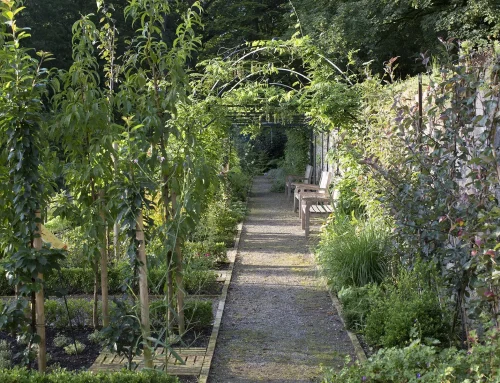
Structure is not an abstract design term. It consists of things you can touch: the layout of paths, the alternation of open space and dense mass, changes in level, walls, steps, a sightline that draws the eye to a particular point. Added to this is the green framework that survives the winter: evergreen shrubs, crisply clipped hedges, a specimen tree that carries weight even without its leaves.
Hornbeam is one example. Strictly speaking, it is not evergreen, but it holds on to its brown leaves for much of the winter. A hornbeam hedge gives a garden walls from November to March where there would otherwise be only emptiness. Elements like these decide whether a garden is still a garden in the cold season or merely a patch of fallow ground.
The Winter Test
Whether a design works is not revealed in June. It is revealed in January. When the garden is bare, its skeleton emerges: the lines, the proportions, the relationship of the spaces to one another. If this skeleton is right, the garden looks ordered and calm even when nothing is in flower. If it is not, all the abundance of summer flowers cannot help, because it only conceals what is missing underneath.
That is why I deliberately test a design against winter. The difference can be shown with two examples. The first garden began with a beautiful perennial mix but no firm framework. In summer it is a feast; in January it is a grey-brown expanse with a few stalks. In the second, there is a clipped hedge, a clear path and a tree in the right place, with the same perennials in between. This garden also rests in winter, but it has form. You can tell that someone has thought it through. That is precisely the difference between planting and a garden.
The Sequence Makes the Difference
This observation leads to a clear sequence in planning. First comes the framework: where the paths run, where the edges lie, where the lawn ends and the paving begins, which spaces are created and how they relate to one another. Only then comes the planting, and it too follows the structure. Perennials and flowers are the layer that brings life and change to a framework that already works without them.
Reversing this sequence and starting with the plant selection is like building a house from the roof down. You may get a beautiful snapshot, but not a garden that keeps its form for ten or twenty years.
Structure Grows Out of the Site
A framework does not fall from the sky, nor does it come out of a catalogue. It develops from what is already there: from the architecture of the house, the lie of the land, the view into the landscape and the aspect. A strict, modern house calls for different lines from an old country estate. A slope needs to be articulated differently from a level site.
That is why a good garden rarely looks as if it had been copied from a picture book. It looks more as if it had always belonged to this house and this place. This effortless sense of belonging is no accident; it is the result of a structure derived from the site rather than imposed on it.
Less, but Done Right
Structure has to do with discipline, and discipline here means leaving things out. A garden that tries to do too much loses its calm. Three materials that recur consistently have a stronger effect than ten that compete with one another. One line drawn cleanly through creates more order than five that cross. Elegance comes not from abundance but from selection.
This also has a practical benefit. A garden with a clear framework is easier to maintain than a purely floral landscape that has to be sustained afresh every year. Hedges, topiary and permanent paving provide stability, even if a perennial bed turns out less dense in a given year. The garden is more forgiving, because its order does not depend on a single flowering season.
The Evergreen Backbone
The green framework relies on a few dependable plants that hold their form all year round. Yew is one such classic: shade-tolerant, tolerant of hard clipping, slow-growing and capable of being shaped over decades. Box, long the backbone of formal gardens, has by contrast been under pressure for years from the box tree moth and fungal disease. Where it once provided the low hedges and spheres, alternatives such as yew or Japanese holly, Ilex crenata, now take over its role.
What matters is that these evergreen elements are placed deliberately and sparingly. Two or three recurring forms are enough to give a garden stability all year round. Mixing many different evergreen species, by contrast, produces not structure but restlessness, which not even winter can resolve.
What Follows from This
If you are thinking about a new garden or a redesign, a simple test is worthwhile: picture your planned garden in winter, without leaves, without flowers, on a grey day. If something remains that you would enjoy looking at, the design has a backbone. If you see only emptiness, the structure is missing, and no amount of careful plant selection will make up for it later.
Flowers are, of course, part of it; for many people they are the very reason for wanting a garden. But they are the reward, not the foundation. A garden that is meant to last for generations must first hold its own in winter. Everything else comes afterwards.